
Is there a return, is there a profit? Checklist throughout the slot round after tumbles
There may have been three rounds that returned money but only one had a net profit. First count the confirmed paid rounds, combine the parts of the return in the correct round, and compare the total return to its stake.

Reels moved, symbols lit up, and a number was added to the display. Is there an award? It’s possible. Was the whole round profitable? That’s a different question. Need to see how much the total is returned compared to the amount deducted for the round.
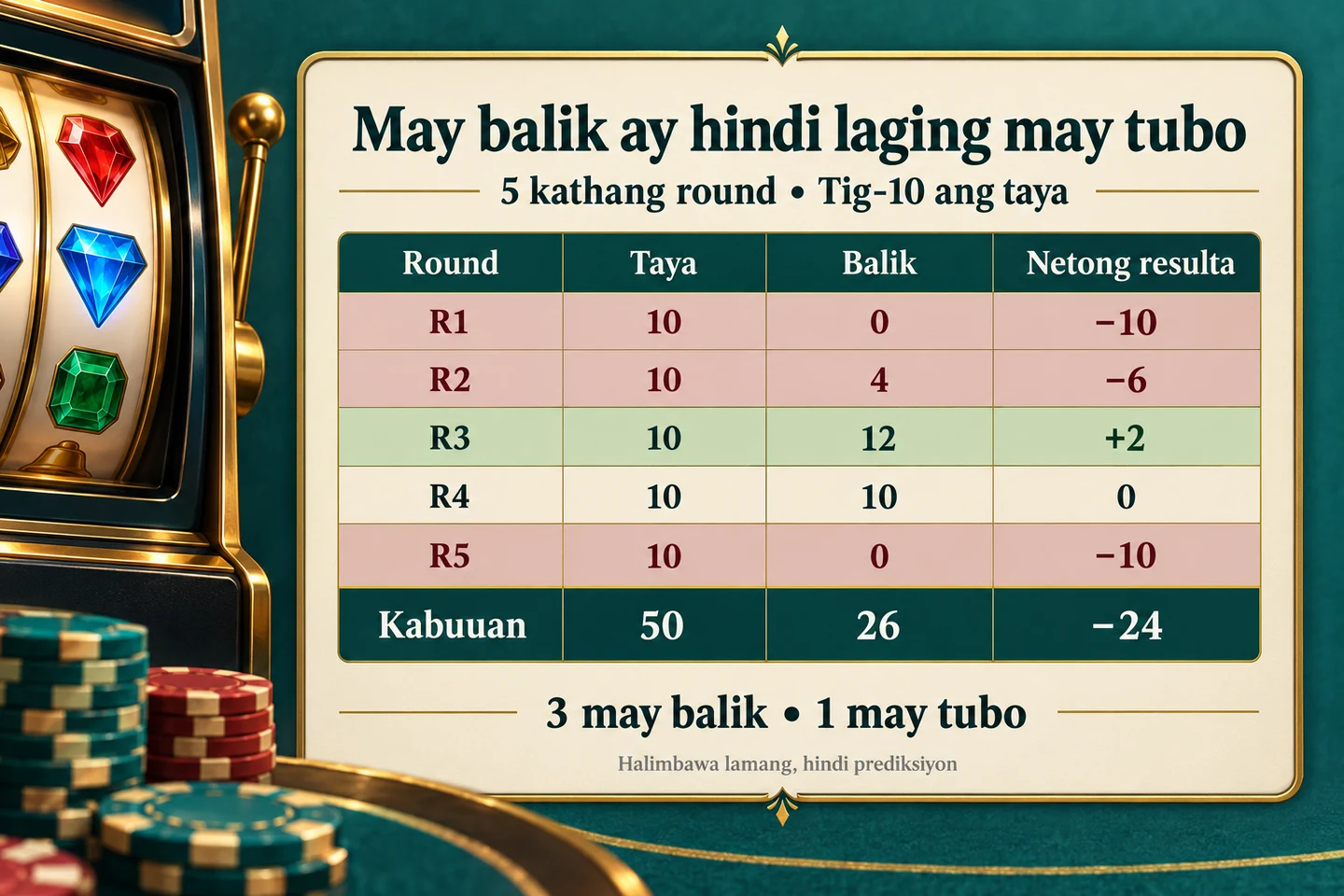
In this fictional worksheet, the stake is 10 units in each of the five paid rounds. There was a return in three, but in only one the return exceeded 10. That difference shows why “three wins” is not clear until it is told what was counted.
First: what is a round on the note you are holding?
There are slot products with successive reel changes in a feature sequence. For example, described by Gates of Olympus Pragmatic Play as with tumbling reels and separate feature mechanics. That’s just a product example; The amounts, stages or history format below are not copied from that game.
For our worksheet, there are five confirmed parent round records, R1 through R5. Each has a single 10-unit debit. Small awards within a row belong to the same round and are not new paid entries. We defined this format ourselves. In a real history, check whether the identifier represents a parent round, subround, feature or transaction; the number of animations on screen is not sufficient.
If there is still a stage that is not finished, do not treat the temporary display as the final total. Confirmed total return and correct stake coverage required. There is also no need to start a new spin to know the status of the previous one.
A small worksheet with full totals
The come back in this article all credit is from that result. The net result is return minus stake. We will not add the stake again to the return of the slots, because it has already been deducted as the cost of the paid round and the meaning of the return column is already set. Accounting units are used, not a game’s cash-conversion rate.
| Parent round | Paid stake | Award components | Total return | Return − stake | Reading in the round |
|---|---|---|---|---|---|
| R1 | 10 | Nothing | 0 | −10 | There is no turning back; there is a net loss |
| R2 | 10 | 4 | 4 | −6 | There is a return, but the stakes are lower |
| R3 | 10 | 3 + 4 + 5 | 12 | +2 | There is a net profit |
| R4 | 10 | 4 + 6 | 10 | 0 | A tie in this round |
| R5 | 10 | Nothing | 0 | −10 | There is no turning back; there is a net loss |
| Total | 50 | 6 positive components | 26 | −24 | Lose the entire five-round sample |
In R2, an award of 4 does not change the fact that the stake is 10: the return is still 6 short. In R4, two components gave a total of 10, but also no net profit. Only R3 has a return higher than cost, and the difference is only 2 units.
Six, three or one: which is the correct number?
All three numbers have obvious uses, but the question they answer is different. May 6 positive award components on the worksheet: one in R2, three in R3 and two in R4. May 3 paid rounds with any return. May 1 paid round with net profit.
If the measure is “rounds with any return”, 3 ÷ 5 = 60% in the sample. As for “rounds with positive net result”, 1 ÷ 5 = 20%. The denominator includes all five paid rounds, plus the two without an award. The denominator is not six because the components are six, nor is it three because there are only three rows with a return.
If you used the number of flashing symbols, sound effects or payout panels, something else is measured. We are not saying that all animations are equivalent to a component. In the worksheet, the six-component count comes from the list explicitly specified, not from viewing the display.
Four checks before the note is called a “winning session”.
- Is the period complete? Include rounds with no return. If the history is filtered to winning entries, that’s not a full sample.
- Is the stake range correct? In the example, a 10-unit debit per parent round. If there is an additional feature purchase or other paid action in the own record, it must be identified separately.
- Final and not double the return? 3, 4 and 5 in R3 are distinct amounts. If an interface displays cumulative totals, the display values cannot simply be combined.
- What conclusion is needed? For the sample total, 26 − 50 = −24. The number of positive-return rows is no substitute for that result.
As a reference that explains why separation is important, the UKGC RTS 14F has a rule against celebrating a return less than or equal to the total stake using win-associated effects. This is a Great Britain technical standard, not a statement about Philippine law or compliance of a game we haven’t reviewed. Our own table is simply the arithmetic of stake and return.
60% and 20% are just descriptions of five fake records
The two percentages are not the probability of the next spin. They also don’t provider hit rate, RTP, or predict long-term results. The numbers are deliberately chosen to have no return, partial return, break-even and profit cases. It does not have random samples or real observed sessions.
For the same reason, the 26 ÷ 50 = 52% ratio of sample return to stake is not theoretical RTP. Different input and analysis is required for published game statistics. It also does not mean that the next round “needs to recover” because the sample net is −24.
Is the round tied when the return equals the stake?
Yes with our accounting model that has no other fees or moves. The net of R4 is zero. This does not erase the loss of other rows, so the total sample is still negative.
What if some returns are pending?
Don’t fill in zeros just to have a complete total. Separate the unresolved records and state only which are settled covered by the computation. Unknown is not the same thing as confirmed zero.
Read the slot round and animation hub and introductory guide to spin and cascades for context. Naa spintime homepage and guide library the other subject. If there is an unclear label or link in the article, use the online chat.