
Craps: why a seven changes meaning after a point is established
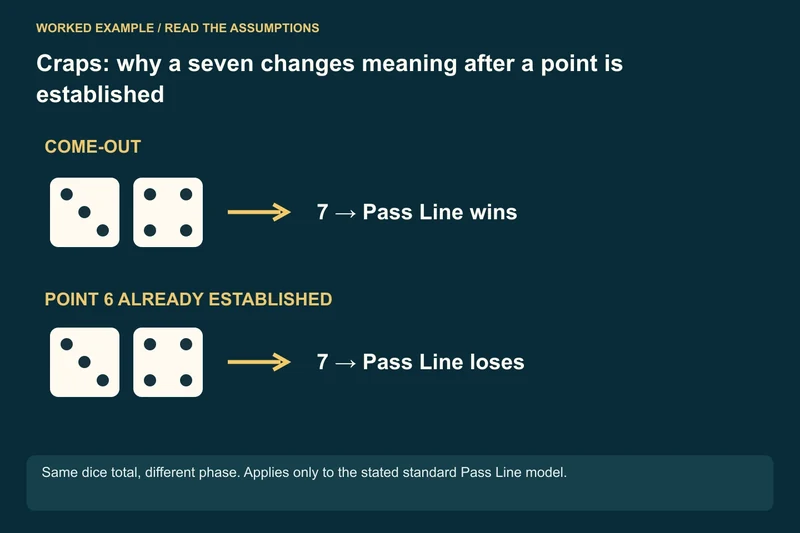
For a standard Pass Line wager, a seven on the come-out roll wins. A seven after a point has been established, before that point repeats, loses the Pass Line wager. The dice total is the same; the game state is different.
For the topic overview, see Detailed guides.
That is why a cropped image of two dice cannot always explain a settlement. You also need the phase and the wager type.

Keep the explanation to one wager
The MGM Resorts GameSense craps guide distinguishes come-out and point phases. We use its standard Pass Line model to explain the state change. Do not transfer this explanation to Come, Don’t Pass, proposition bets or a different dice-game variant.
At the start, the come-out roll may settle the Pass Line immediately or establish a point. Once a point is established, the relevant question is whether that point repeats before a seven. Other totals do not all have the same consequences as they did on the come-out roll.
Follow two short, invented sequences
| Sequence | State just before seven | Pass Line meaning of seven |
|---|---|---|
| First roll is 3+4 = 7 | Come-out; no point established | Win |
| First roll is 2+4 = 6; next is 3+4 = 7 | Point 6 established and not repeated | Lose |
Both sequences end with dice showing three and four. In the second, the previous six supplies the missing context. Removing that earlier event makes the last image ambiguous. The exact stake and payout amount are separate questions that this example does not need.
A point marker is useful evidence, not a whole receipt
A visible marker can help identify the active point, but a full record should still show the roll sequence and accepted wager. A marker on six does not prove that every chip on the layout is a Pass Line wager. Different locations can represent different rules.
Write a small state log: before the first roll, come-out; after the six, point six; after the seven, the illustrated Pass Line resolves as a loss. This is more informative than recording only “seven appeared.”
Do not confuse the explanation with a prediction
The previous six changes the settlement condition; it does not tell the reader that a seven is about to arrive. The example assumes the observed sequence and explains it after the fact. It supplies no betting system, probability estimate or reason to chase another round.
For a disputed record, ask which phase applied, what point was active, what the roll sequence showed and which wager was accepted. Those concrete questions recover the missing context without claiming that a familiar dice total must always be favorable or unfavorable.
The spintime homepage brings together the site’s other reading topics.
Source-based editorial research and original examples. Sources checked 9 October 2026. No real-money play or account transaction was performed for this article.